OBJECTIVES
7.1
Guided by the cornerstone principles of "Ageing in Place" and "Continuum of Care", the overall aim of services for the elderly is to assist elderly persons to continue living in the community for as long as possible. Residential care services should be the last resort for frail elderly persons who require intensive personal and nursing care.
SERVICE PROVISION AND STATISTICS
7.2
The service provision and statistics are as follows:
| Community Support Services for Elderly Persons |
No. of Centres/Teams
(No. of Places)
[as at 31 March 2016] |
No. of Centres/Teams
(No. of Places)
[as at 31 March 2017] |
| District Elderly Community Centres |
41 centres |
41 centres |
| Neighbourhood Elderly Centres |
169 centres |
169 centres |
| Social Centres for the Elderly |
1 centres |
1 centres |
| Day Care Centres/Units for the Elderly |
72 centres
(3 039 places) |
73 centres
(3 059 places) |
| Integrated Home Care Services |
60 teams |
60 teams |
| Home Help Service |
1 team |
1 team |
| Enhanced Home and Community Care Services |
34 teams
(7 245 places) |
34 teams
(7 245 places) |
| Residential Care Services for the Elderly |
No. of Homes
(No. of Subsidised Places)
[as at 31 March 2016] |
No. of Homes
(No. of Subsidised Places)
[as at 31 March 2017] |
| Subvented Residential Care Homes for the Elderly |
121 homes
(15 399 places) |
121 homes
(15 286 places) |
| Subvented Nursing Homes |
6 homes
(1 574 places) |
6 homes
(1 574 places) |
| Contract Homes |
26 homes
(1 991 places) |
28 homes
(2 150 places) |
| Self-financing Homes Participating in Nursing Home Place Purchase Scheme |
6 homes
(241 places) |
5 homes
(296 places) |
| Private Homes Participating in Enhanced Bought Place Scheme |
142 homes
(8 048 places) |
142 homes
(8 087 places) |
HIGHLIGHTS OF THE PERIOD
COMMUNITY CARE AND SUPPORT SERVICES FOR ELDERLY PERSONS
7.3
Anticipating the challenges brought about by the ageing population, the SWD adopted more holistic and comprehensive approaches to promote active and healthy ageing through a series of public education and publicity programmes. In line with the elderly persons' preference to age at home and to support their families in taking care of them, the SWD implemented a host of initiatives to enable more frail and cognitively impaired elderly persons to benefit from the expansion of enhanced services which were tailor-made, innovative, appropriate and cost-effective in meeting their multifarious needs.
COMMUNITY SUPPORT SERVICES
DISTRICT-BASED SCHEME ON CARER TRAINING
7.4
Since October 2007, the District-based Scheme on Carer Training has been launched in elderly centres to organise carer training programmes for enhancing carers' capability of taking care of elderly persons. To further enhance the training for carers, the Scheme has been regularised from 2014-15. An additional annual recurrent funding of some $6.7 million has been provided to subvented elderly centers for organising training activities for carers.
PILOT SCHEME ON LIVING ALLOWANCE FOR CARERS OF ELDERLY PERSONS FROM LOW INCOME FAMILIES
7.5
The SWD launched the Pilot Scheme on Living Allowance for Carers of Elderly Persons from Low Income Families in June 2014 to provide carers of elderly persons from low income families with a living allowance to help supplement their living expenses so that elderly persons in need of long term care services can, under the help of their carers, receive proper care and to enable them to remain in the community. The second phase of the Pilot Scheme was rolled out in October 2016 for 2 years, bringing the target total number of beneficiaries under the 2 phases of the Pilot Scheme to 4 000.
PILOT SCHEME ON COMMUNITY CARE SERVICE VOUCHER FOR THE ELDERLY
7.6
The SWD implemented the first and second phases of the Pilot Scheme on Community Care Service Voucher for the Elderly in September 2013 and October 2016 respectively. The Pilot Scheme aims at testing the viability of a new funding mode whereby the Government adopts a "money-following-the-user" approach and provides subsidy directly for the service users (instead of service providers) in the form of service voucher. Eligible elderly persons may choose the service provider, the type of service and the service package that suit their needs. As at 31 March 2017, a total of 6 341 elderly persons had participated in the Scheme under the two phases.
DAY CARE SERVICES
7.7
The SWD continued to increase the provision of day care services in the districts with high demand. As at 31 March 2017, 73 day care centres/units for the elderly (DEs/DCUs) provided a total of 3 059 day care places, with an increase of 20 places as compared with that as at 31 March 2016. A total of 4 470 elderly persons, including full-time and part-time users, were receiving day care services in these DEs/DCUs. Extended Hours Service was also implemented in new DEs/DCUs from 6 to 8 pm on Mondays to Saturdays and 8 am to 6 pm on Sundays and Public Holidays, which aims to relieve the pressure on carers, in particular for those who have long working hours, have to concurrently take care of other family members, or have ad hoc engagements that temporarily prevent them from taking care of the elderly persons.
HOME CARE SERVICES
7.8
As at 31 March 2017, 34 EHCCS teams provided a total of 7 245 places. The EHCCS were enhanced to include elder-sitting and on-site carer training from 1 March 2015 to strengthen the support for frail elderly persons who have been assessed under the Standardised Care Need Assessment Mechanism for Elderly Services to have moderate or severe level of impairment to continue living at home and to maintain their maximum level of functioning. Besides, 60 integrated home care services teams served a total of 26 820 cases, including ordinary and frail cases in 2016-17.
OPPORTUNITIES FOR THE ELDERLY PROJECT
7.9
Under the Project, subsidies are provided to social service organisations, district organisations and educational institutes, etc. to organise a wide range of programmes, such as promoting life-long learning, community participation, inter-generational solidarity and volunteerism, etc. to promote a sense of worthiness among elderly persons and to instill a caring spirit in the community. A total of 540 projects were launched in 2015-16 and 2016-17 by various organisations, attracting over 167 600 elderly participants. Commencing from 2012, projects lasting for two years, in addition to the usual one-year projects, were also funded.
RESIDENTIAL CARE SERVICES FOR THE ELDERLY
7.10
While the majority of our elderly persons are healthy, some, for personal, social, health and/or other reasons, cannot be adequately taken care of at home. These frail elderly persons are in need of residential care so that they can achieve the optimal level of independence and social participation through nursing and personal care and social activities. In order to target resources at elderly persons with genuine care needs and to enhance their quality of life whilst staying in residential care homes for the elderly (RCHEs), the SWD has implemented a number of service initiatives with enhanced monitoring of service quality.
SERVICE IMPROVEMENT MEASURES OF RESIDENTIAL CARE HOMES FOR THE ELDERLY
7.11
The Residential Care Homes (Elderly Persons) Ordinance, Cap. 459, provides for the control and monitoring of RCHEs through a licensing scheme managed by the SWD. The SWD has taken a number of service improvement measures to further upgrade the service quality of RCHEs. These initiatives include:
- The Government has implemented a three-year Pilot Scheme on Visiting Pharmacist Services since June 2010 to provide and subsidise registered pharmacists to strengthen the drug management capability of RCHEs. The Pilot Scheme was extended to 2015-16 and 2016-17.
- The SWD and the Department of Health organised eight and nine (including the Management Workshop on 3.2.2016) workshops in 2015 and 2016 respectively to provide training for RCHE staff, and drug management was one of the major training items.
- The SWD implemented a two-year Quality Improvement Project for RCHEs supported by the LF in 2016 to develop the capacity of RCHE operators/home managers for effective management of RCHEs and help RCHEs set up effective management system and protocols on health care.
PROVISION OF RESIDENTIAL CARE PLACES
7.12
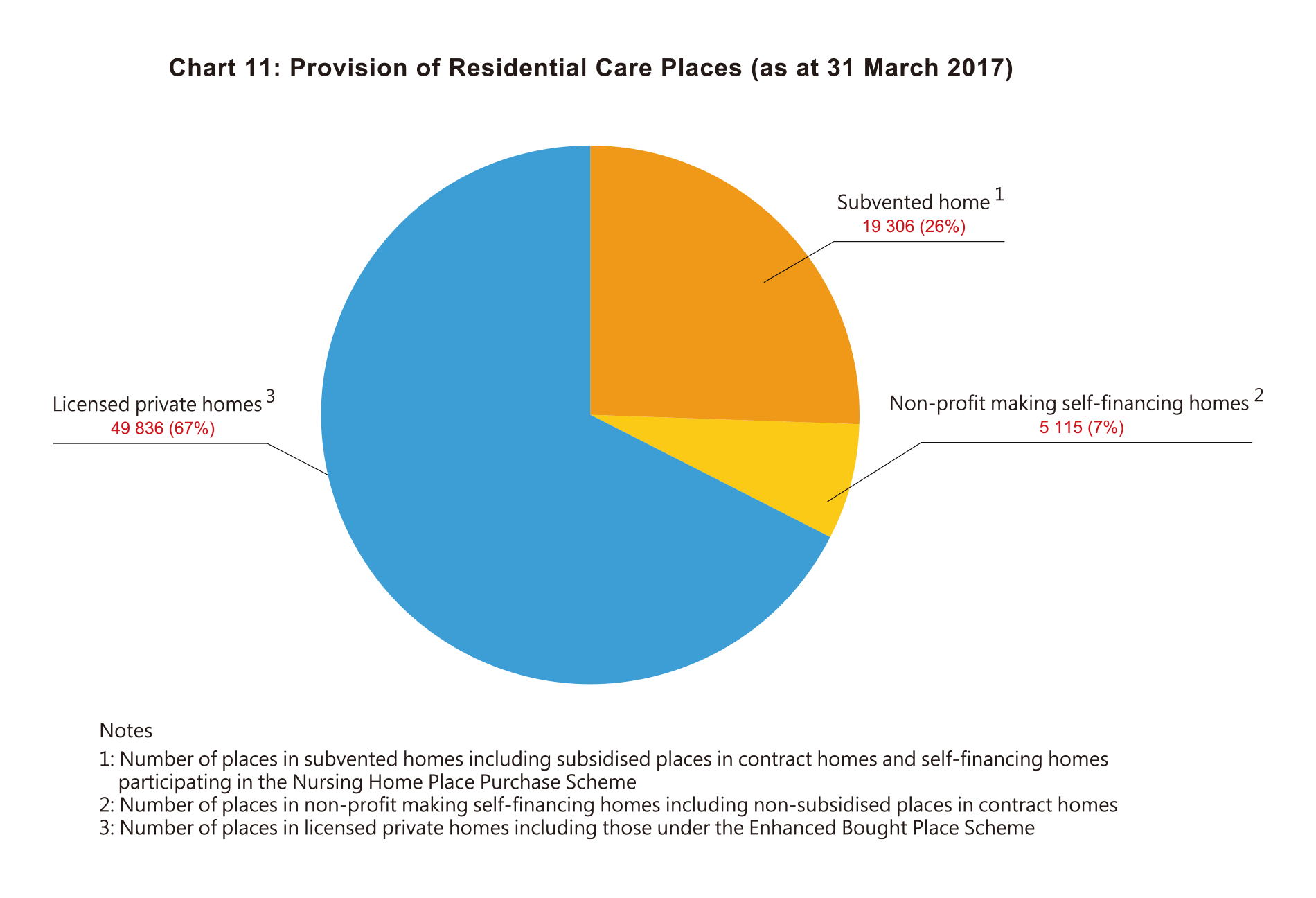
As at 31 March 2017, there were a total of 74 257 residential care places for the elderly with varying care needs in Hong Kong. Government subsidised places are provided through subvented RCHEs, contract homes, purchase of places from the private sector under the Enhanced Bought Place Scheme and from the self-financing sector under the Nursing Home Place Purchase Scheme. At the same time, self-care hostel and home-for-the-aged places have been gradually converted into care-and-attention places to provide a continuum of care to meet the care needs of the elderly persons. The number of subsidised residential care places for the elderly has been increased from 26 872 as at 31 March 2015 to 27 393 as at 31 March 2017. Chart 11 below shows the provision of residential care places as at 31 March 2017.
PILOT RESIDENTIAL CARE SERVICES SCHEME IN GUANGDONG
7.13
The Pilot Residential Care Services Scheme in Guangdong, launched in June 2014, provides an option for elderly persons who are on the central waiting list for subsidised care-and-attention places to receive residential care services at the Hong Kong Jockey Club Shenzhen Society for Rehabilitation Yee Hong Heights in Shenzhen or the Hong Kong Jockey Club Helping Hand Zhaoqing Home for the Elderly in Zhaoqing. As at 31 March 2017, 129 elderly persons had chosen to reside in the elderly home in Shenzhen and 18 in Zhaoqing.
PILOT SCHEME ON RESIDENTIAL CARE SERVICE VOUCEHR FOR THE ELDERLY
7.14
The Pilot Scheme on Residential Care Service Voucher (RCSV) for the Elderly launched in March 2017 by the SWD, adopting the "money-following-the-user" principle, gives an additional choice for elderly persons in need of residential care service and provides incentive for residential care homes for the elderly to improve their services. The Pilot Scheme is implemented in three phases with a total of 3 000 RCSVs to be issued from 2017 to 2019 by five batches.
ENROLLED NURSE TRAINING PROGRAMME FOR THE WELFARE SECTOR
7.15
The SWD, with the assistance of the Hospital Authority, launched the two-year, full-time Enrolled Nurse (General)/Enrolled Nurse (Psychiatric) training programmes for the welfare sector from October 2013 to February 2014 to address the nursing shortage in the sector, in particular elderly services and rehabilitation services. Since 2006, a total of 14 classes with 1 790 Enrolled Nurse training places have been provided, with priority accorded to individuals currently working in the sector. Another 920 training places will be provided in the coming few years. With tuition fees fully subsidised by the SWD, graduates are required to work in the welfare sector for at least two years after graduation.
NAVIGATION SCHEME FOR YOUNG PERSONS IN CARE SERVICES
7.16
The Navigation Scheme for Young Persons in Care Services, launched in July 2015, providing a total of 1 000 training places in several years starting from 2015-16 to encourage young persons to join the elderly and rehabilitation care services. The 5 non-governmental operating agencies selected by the SWD started recruitment of trainees in July 2015 and April 2016 respectively. As at end-March 2017, a total of 569 trainees had been recruited by these 5 operating agencies.
CONTRACT MANAGEMENT
7.17
The SWD continues to adopt competitive bidding for selecting suitable operators to provide residential care services for elderly persons in purpose-built RCHE premises. The bidding for services is based on quality and service volume and is open to NGOs and organisations from the private sector. As at 31 March 2017, 28 contract homes, 12 of them with DCUs, provided a total of 2 150 subsidised residential care places and 292 subsidised day care places. Moreover, these 28 contract homes also provided 1 414 non-subsidised residential care places for a reasonable fee.
7.18
The performance of services under contracts is monitored closely by the Contract Management Section through measures including:
- regular audits of service statistics and information;
- regular service reviews;
- unannounced visits; and
- complaints investigation.