OBJECTIVES
8.1
Rehabilitation services aim at assisting persons with disabilities to become full members of the community by developing their physical, mental and social capabilities to the fullest possible extent and by promoting their integration into the community.
SERVICE PROVISION
8.2
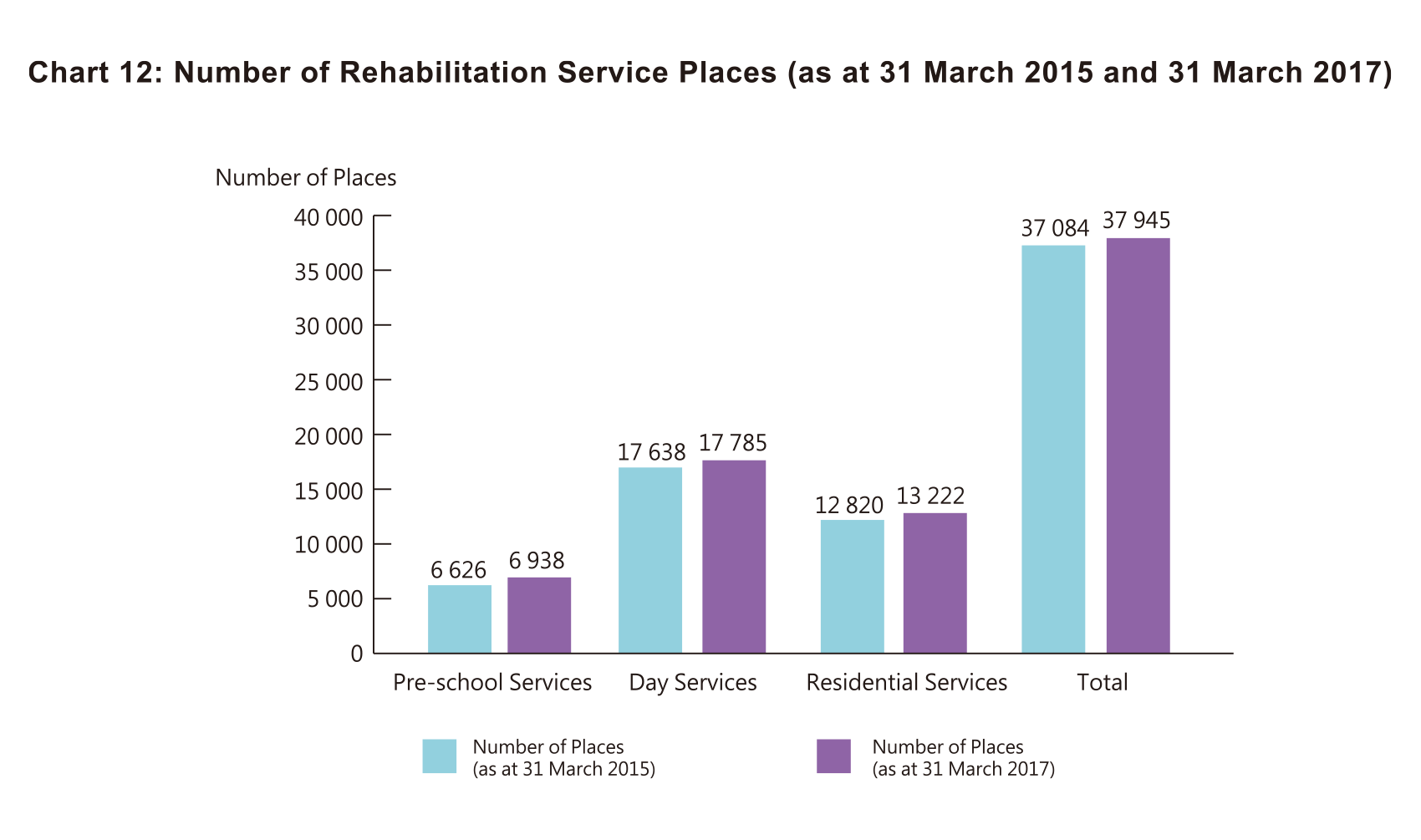
To achieve the above aims, the SWD, through subvention to NGOs, provides a full range of social rehabilitation services for persons with disabilities. At the end of March 2017, there were 6 938 pre-school places, 17 785 day places and 13 222 residential places. The breakdown of service places as at 31 March 2017 is shown in the table below, while the number of rehabilitation service places as at 31 March 2015 and 31 March 2017 is shown in
Chart 12.
| |
Places |
| Pre-school Services |
| Early Education and Training Centre |
3 124 |
| Special Child Care Centre |
1 834 |
| Integrated Programme in Kindergarten-cum-Child Care Centre |
1 980 |
| Sub-total |
6 938 |
| Day Services |
| Day Activity Centre |
5 198 |
| Sheltered Workshop |
5 276 |
| Supported Employment |
1 633 |
| Integrated Vocational Rehabilitation Services Centre |
4 482 |
| Integrated Vocational Training Centre (Day Service) |
453 |
| On the Job Training Programme for People with Disabilities |
432 |
| Sunnyway - On the Job Training Programme for Young People with Disabilities |
311 |
| Sub-total |
17 785 |
| |
Places |
| Residential Services |
| Residential Special Child Care Centre |
110 |
| Long Stay Care Home |
1 587 |
| Halfway House |
1 509 |
| Hostel for Moderately Mentally Handicapped Persons |
2 505 |
| Hostel for Severely Mentally Handicapped Persons |
3 611 |
| Care-and-Attention Home for Severely Disabled Persons |
991 |
| Hostel for Severely Physically Handicapped Persons |
573 |
| Care-and-Attention Home for the Aged Blind |
825 |
| Supported Hostel |
677 |
| Small Group Home for Mildly Mentally Handicapped Children/Integrated Small Group Home |
64 |
| Integrated Vocational Training Centre (Residential Service) |
170 |
| Bought Place Scheme for Private Residential Care Homes for Persons with Disabilities |
600 |
| Sub-total |
13 222 |
| Grand Total |
37 945 |
8.3
The Community Care Fund (CCF) "Training Subsidy for Children who are on the Waiting List of Subvented Pre-school Rehabilitation Services" assistance programme had been regularised since 1 October 2014. The Programme aims to provide training subsidy for children from low income family on the waiting list of subvented pre-school rehabilitation services, which enables them to acquire training and treatment provided by recognised service providers so as to facilitate their learning and development while waiting for subvented services. As at 31 March 2017, there were 362 higher level subsidy places for children waitlisted for SCCCs, and 1 060 normal level subsidy places for children waitlisted for early education and training centres or the Integrated Programme in KG-cum-CCCs.
HIGHLIGHTS OF THE PERIOD
NEW PROVISIONS OF FACILITIES AND INITIATIVES
8.4
To meet the demand for services, 861 new places were added in 2015-16 and 2016-17 including 312 places for pre-school services, 147 places for day services and 402 places for residential services.
DISTRICT SUPPORT CENTRE FOR PERSONS WITH DISABILITIES
8.5
To strengthen the support to persons with disabilities and their families who are living in the community, the SWD set up 16 district support centres for persons with disabilities (DSCs) in January 2009 through re-engineering of home-based training and support service. As at 31 March 2017, 13 DSCs provided service at their permanent accommodation, and one is expected to provide service in its permanent accommodation in 2017-18 upon completion of fitting-out works. The SWD has also identified premises for one DSC at new development project. The SWD will closely monitor the progress and continue to identify suitable premises for the remaining DSC.
HOME CARE SERVICE FOR PERSONS WITH SEVERE DISABILITIES
8.6
Given the conditions of persons with severe physical and/or intellectual disabilities and the level and intensity of care they require, the SWD is mindful of their special caring needs and the immense pressure faced by their family members in caring for them at home. To strengthen the support for this vulnerable group, the SWD has regularised the service after its 3-year pilot scheme in March 2014 and extended the service to all districts in Hong Kong and to cover persons with severe disabilities who are not on the waiting lists for subvented residential care services with a package of integrated home-based services to meet their care, nursing and rehabilitation training needs.
INTEGRATED SUPPORT SERVICE FOR PERSONS WITH SEVERE PHYSICAL DISABILITIES
8.7
To fully address the needs of persons with severe physical disabilities and give them targeted support, the SWD implemented the Integrated Support Service for Persons with Severe Physical Disabilities (ISS) and regularised the two assistance programmes for dependents of respiratory support medical equipment under the CCF in November 2014. The ISS renders support to persons with severe physical disabilities who need constant attention and care by relieving them of the burden of medical equipment and medical consumables, and enabling them to continue living in their familiar community. The ISS, implemented through case management approach, provides one-stop support services, including casework counselling, occupational therapy/physiotherapy, nursing care service and financial support service.
INTEGRATED COMMUNITY CENTRE FOR MENTAL WELLNESS
8.8
In October 2010, the SWD revamped the existing community mental health support services to set up integrated community centres for mental wellness (ICCMWs) in the territory through 24 service points. ICCMWs aim at providing one-stop, district-based and accessible community support and social rehabilitation services ranging from early prevention to risk management for discharged mental patients, persons with suspected mental health problems, their families/carers and residents living in the serving district.
PILOT SCHEME ON ON-SITE PRE-SCHOOL REHABILITATION SERVICES
8.9
In view of the importance of early intervention to children with special needs, the Government launched a two-year Pilot Scheme on On-site Pre-school Rehabilitation Services through the LF in November 2015 in phases. The scheme offers on-site rehabilitation services for children with special needs, who are studying in participating kindergartens and kindergarten-cum-child care centre. Currently, there are 16 NGO operators providing about 3 000 training places for children studying in over 480 KGs/KG-cum-CCCs. Other than children with special needs, the multi-disciplinary service teams will also provide professional support for kindergarten teachers/children care workers and parents.
TRAINING SUBSIDY PROGRAMME FOR CHILDREN ON THE WAITING LIST OF SUBVENTED PRE-SCHOOL REHABILITATION SERVICES
8.10
To enhance the training and provide more comprehensive support services for children from low-income family and with more severe developmental problems, the maximum subsidy for eligible children waitlisted for special child care centre had been increased to $5,995 per month from 1 October 2016 onwards for increasing their training hours.
PILOT PROJECT ON STRENGTHENING SUPPORT FOR PERSONS WITH AUTISM AND THEIR PARENTS/CARERS
8.11
With the funding support from the LF, the SWD commissioned two NGOs to implement a 30-month Pilot Project on Strengthening Support for Persons with Autism and their Parents/Carers since April 2016. Through multi-disciplinary teams (including clinical psychologist, social worker and occupational therapist), the Pilot Project aims to strengthen support for young persons with high functioning autism, their parents/carers as well as subvented rehabilitation units serving persons with autism and the frontline workers concerned. The project is expected to provide services for no less than 400 cases of young persons with high-functioning autism and their parents/carers. Besides, the SWD has commissioned an academic institution to conduct an evaluation on the effectiveness of the Pilot Project.
PILOT PROJECT ON PEER SUPPORT SERVICE IN COMMUNITY PSYCHIATRIC SERVICE UNITS
8.12
The SWD, through the funding support from the LF, has implemented the 2-year Pilot Project on Peer Support Service in Community Psychiatric Service Units since March 2016. The Pilot Project aims to equip suitable ex-mentally ill persons as peer supporters for speeding up their own recovery and supporting other mentally ill patients on their way to recovery, and to enhance the public's positive understanding of the ex-mentally ill persons.
PILOT SCHEME ON LIVING ALLOWANCE FOR LOW-INCOME CARERS OF PERSONS WITH DISABILITIES
8.13
The SWD launched the 2-year Pilot Scheme on Living Allowance for Low-income Carers of Persons with Disabilities in October 2016. This Pilot Scheme aims at providing carers of persons with disabilities from low income families with a living allowance to help supplement their living expenses so that persons with disabilities in need of long term care services can, under the help of their carers, receive proper care and to enable them to remain in the community. The Pilot Scheme will benefit a total of 2 000 carers.
INITIATIVES FOR AGEING SERVICE USERS
8.14
To cater for the special needs of the ageing service users in rehabilitation facilities, the SWD has since 2005 put in place a number of initiatives which include the Extended Care Programme (ECP), the Work Extension Programme (WEP), the Visiting Medical Practitioner Scheme (VMPS), the Enhanced Physiotherapy Service and Health Care. Since November 2013, additional recurrent funding has been provided to residential care homes for persons with intellectual or physical disabilities as well as sheltered workshops (SWs)/integrated vocational rehabilitation services centres (IVRSCs) operating the WEP and day activity centres (DACs) operating the ECP to enhance the care and support services for ageing service users. Additional recurrent funding has also been provided to SWs/IVRSCs and DACs since October 2014 to further enhance the care and support services for ageing service users. Moreover, additional provision of 645 WEP places and 895 ECP places has been put in place in the 1st quarter of 2015. In 2015-16, recurrent expenditure has been increased to enhance the care staff manpower of long stay care homes for ex-mentally ill persons and strengthen the allied health services of hostels for moderately mentally handicapped persons, so as to provide care and support for ageing service users. In 2016-17, recurrent provision for the VMPS has been increased to strengthen the provision of primary medical care and support for residents of subvented residential care homes for persons with disabilities. To cater for the needs of ageing users of rehabilitation services to go out for medical consultation and other activities, starting from 2016-17, additional recurrent provision has been provided for DACs cum hostels for severely mentally handicapped persons and community rehabilitation day centres to hire drivers and strengthen their centre bus services. The LF has also been applied for procurement of centre buses for these hostels/centres.
PROMOTING SELF-RELIANCE
VOCATIONAL REHABILITATION SERVICE
8.15
In sum, vocational rehabilitation services to promote self-reliance for persons with disabilities include:
- 12 587 places in sheltered workshops, supported employment, integrated vocational rehabilitation services centre, integrated vocational training centres, the On the Job Training Programme for People with Disabilities, and Sunnyway - On the Job Training Programme for Young People with Disabilities were provided for persons with disabilities as at 31 March 2017.
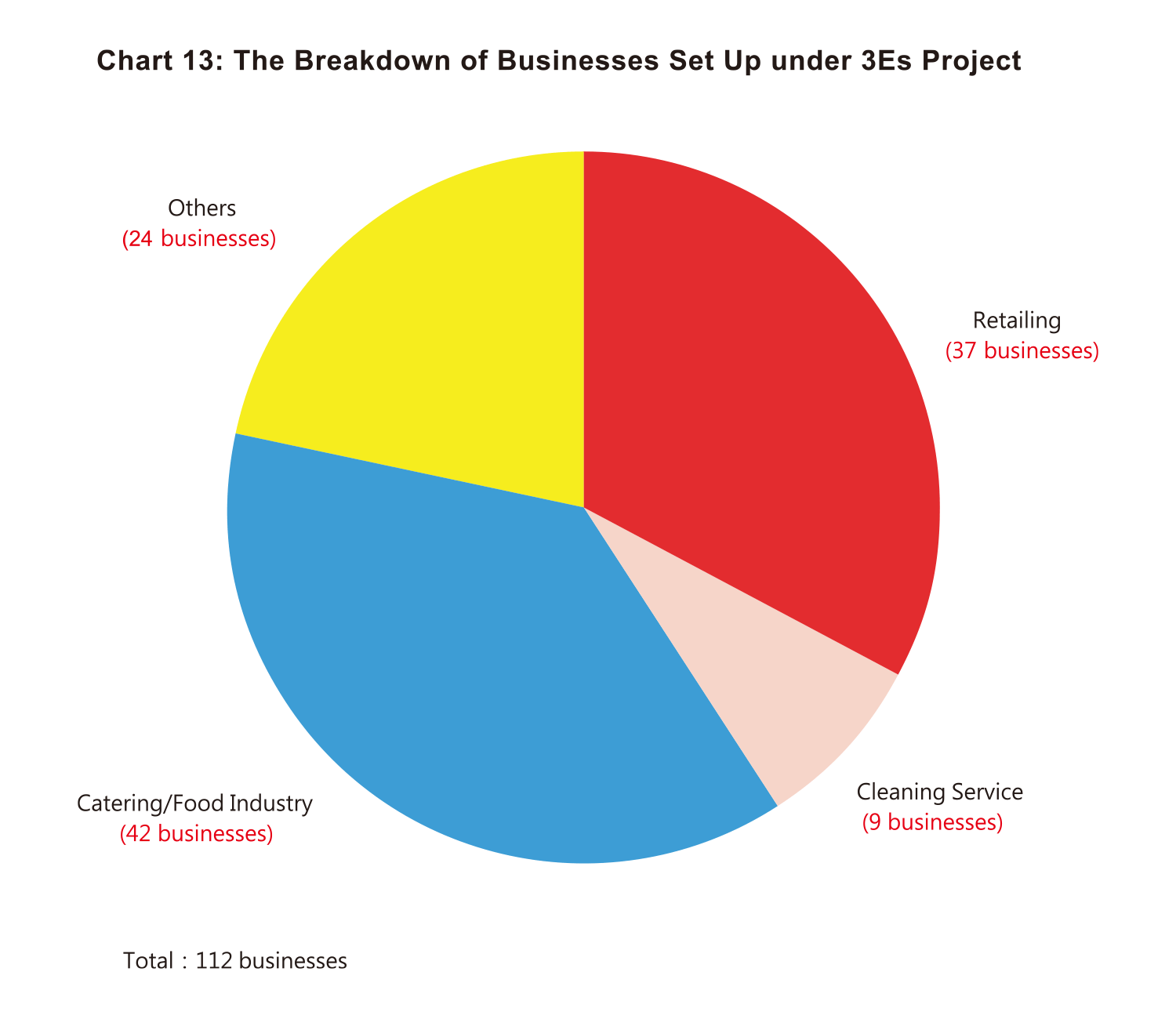
- The Enhancing Employment of People with Disabilities through Small Enterprise Project (3Es Project) aims at enhancing the employment of persons with disabilities through direct creation of jobs, providing seed money to NGOs to create small businesses with the condition of employing no less than 50% of persons with disabilities in the total number of persons on the pay-roll. As at 31 March 2017, 112 businesses such as cleaning services, food and beverage, eco-tourism, car beauty services, massage services provided by visually impaired persons, retail shops, vegetable supply and processing, etc. were set up through the support of the 3Es Project, creating around 1 162 employment opportunities, including around 819 for persons with disabilities. The breakdown is shown in Chart 13 below:
MARKETING CONSULTANCY OFFICE (REHABILITATION)
8.16
The objective of the Marketing Consultancy Office (Rehabilitation) [MCO(R)] is to enhance employment and training opportunities for persons with disabilities through innovative, effective and efficient business development and marketing approaches. Services of the MCO(R) include assisting NGOs in the setting up of social enterprises and small businesses under the 3Es Project, promoting the products produced and services provided by persons with disabilities through the brand of "Let Them Shine" and strengthening NGOs' cooperation with the Government and private sectors.
SUPPORT PROGRAMME FOR EMPLOYEES WITH DISABILITIES
8.17
The Support Programme for Employees with Disabilities was launched in June 2013. It provides subsidies to employers of persons with disabilities for procurement of assistive devices and/or workplace modifications to facilitate the work of employees with disabilities and to enhance their work efficiency. Employers of persons with disabilities may apply for a one-off subsidy up to $20,000 for each employee with disabilities. The scheme has been enhanced since April 2014, including raising the maximum support level of $40,000 for procurement of a single assistive device and its essential accessories.
CONTINUING COMMUNITY SUPPORT
SUPPORT TO PERSONS WITH DISABILITIES LIVING IN THE COMMUNITY
8.18
The SWD has implemented a new package of three-year community-based support projects since January 2015. It aims at strengthening the caring capability of the carers to relieve their caring burden as well as improving the quality of life for persons with disabilities and their families. Projects funded under this package include personal and art development programmes, specialised programmes for persons with autism and mentally handicapped persons with challenging behavior, support schemes for newly blind persons and support services for children with special needs and their families and professional consultancy/support/ training services to self-help organisations of persons with disabilities.
FUNDING SUPPORT TO SELF-HELP ORGANISATIONS AND PARENTS' ASSOCIATIONS
8.19
Funding support in an annual sum of 15 million was provided to a total of 83 self-help organisations of persons with disabilities (SHOs) in 2016-18 to help the development of SHOs to enhance the promotion of self-help spirit among persons with disabilities and their carers.
LICENSING SCHEME FOR RESIDENTIAL CARE HOMES FOR PERSONS WITH DISABILITIES
8.20
The Residential Care Homes (Persons with Disabilities) Ordinance (Cap. 613) commenced operation on 18 November 2011 and was fully implemented on 10 June 2013, providing for the control of RCHDs through a licensing scheme administered by the Director of Social Welfare (DSW). RCHDs that existed before the commencement of the Ordinance but were not yet able to fully comply with the licensing requirements may apply for Certificates of Exemption (CoEs), so as to allow time for them to carry out improvement works to comply with the licensing requirements and standards.
8.21
The Licensing Office of Residential Care Homes for Persons with Disabilities (LORCHD) of the SWD performs the statutory duties in relation to the licensing scheme. The inspectorate teams of the LORCHD conduct regular inspections in respect of building safety, fire safety, health care and home management to ensure that RCHDs comply with the statutory requirements in staffing, space and layout, building structure, precautionary measures and quality of care, etc.
8.22
To tie in with the implementation of the licensing scheme, the SWD introduced the Financial Assistance Scheme for Private RCHDs in December 2011 to provide subsidies for private RCHDs in operation before the commencement of the Ordinance to carry out improvement works for compliance with the licensing requirements in building and fire safety. The SWD has also launched the Bought Place Scheme (BPS) for Private RCHDs which aims at encouraging private RCHDs to upgrade their service standards, increasing the supply of subsidised residential care places, thereby shortening the waiting time for subsidised residential service; and helping the market provide more service options for persons with disabilities. As at 31 March 2017, 10 private RCHDs had joined the BPS, providing a total of 600 BPS places.
8.23
To enhance the caring skills of the RCHD staff, the SWD, in collaboration with Department of Health and relevant professionals, has been organising training programmes, covering subjects such as infection control, management of psychotropic drugs and understanding the social, recreational and developmental needs of persons with disabilities, etc. The SWD also invited training institutes to organise a series of health worker (HW) training courses. As at 31 March 2017, 23 training institutes have obtained SWD's approval for organising 74 training courses applicable to RCHDs and LORCHD had arranged registration for more than 3 200 HWs who completed the HW training courses in accordance with the RCHD Regulation. Besides, a 15-month project, funded by the LF, was launched in July 2016 to, inter alia, enhance the management skills of operators or managers and provide consultation to individual RCHDs in respect of the management of the homes.
PROVISION OF INFORMATION TECHNOLOGY SUPPORT FOR PERSONS WITH DISABILITIES IN NEED
CENTRAL FUND FOR PERSONAL COMPUTERS
8.24
The Central Fund for Personal Computers was set up in 1997 to assist eligible persons with disabilities to acquire computer facilities for self-employment or receiving supported employment at home. As at 31 March 2017, the Fund had granted a total of $4.49 million to 356 applicants.
JOCKEY CLUB IT SCHEME FOR PEOPLE WITH VISUAL IMPAIRMENT
8.25
The Jockey Club IT Scheme for People with Visual Impairment was set up under the auspices of the Hong Kong Jockey Club Charities Trust in October 2005. The Scheme aims at supporting organisations to acquire high-performance Chinese screen readers and Braille displays for installation at communal access points to facilitate the access of persons with visual impairment (PVI) to IT, and to subsidise individual PVI with genuine financial difficulty to acquire these computer assistive devices for the purpose of studies or employment. The Scheme has been further enhanced since October 2015, including expansion of coverage on subsidy to purchase accessories/portable devices for PVI. As at 31 March 2017, 43 organisational applications and 159 individual applications were supported with $5.65 million committed.
PURSUING EXCELLENCE
HONG KONG PARALYMPIANS FUND
8.26
The Hong Kong Paralympians Fund (HKPF) aims at fostering the development of sports for athletes with disabilities and to support their pursuit of sporting excellence in international events. To enhance the sustainability of the HKPF, an amount of $200 million was approved by the Finance Committee to be injected into the Fund as seed money in 2013-14. In 2015-16 and 2016-17, a total of $12.21 million was approved for allocation. Of the $12.21 million, $7.16 million was allocated to the sports associations for supporting their development of target sports, which included swimming, athletics, table-tennis, rowing, gymnastic, skating, floor hockey, snowshoeing, boccia, badminton, wheelchair fencing, riding, shooting, wheelchair basketball, archery and sailing; $4.67 million to the athletes with disabilities for them to pursue sporting excellence; and $0.38 million to retired athletes with disabilities to assist in their job attachment in sports related fields, other suitable employment or vocational training.